
Kashmir and Central Asia may lie in different geographical regions, but centuries of cultural exchange have left lasting imprints on their artistic and spiritual traditions. Historical connections forged through the Silk Road and the Islamic Golden Age helped shape shared traditions in literature, music, dance, Sufi mysticism, architecture, handicrafts and cuisine.
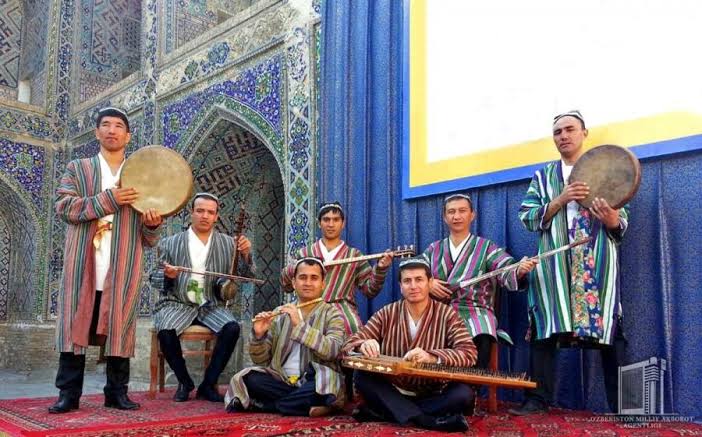
One of the less explored links between Kashmir and Central Asia is the influence of Persian and Central Asian musical traditions on Kashmiri Sufi poetry. The Eastern Maqam tradition, known in Uzbekistan as Shashmaqam, is closely associated with Central Asia’s musical heritage. Its links with Kashmir’s Sufiyana Mausiqi, or Sufiyana Kalam, offer a glimpse into how musical and cultural traditions travelled across regions and evolved through interaction with local languages and artistic forms.
Kashmiri classical music has evolved through the interaction of folk and classical traditions. Sufiyana Mausiqi is an ensemble-based musical tradition built around the concept of maqam, or melodic modes. Related traditions are known as maqamat in Persian and Arabic musical contexts and maqomat in Uzbekistan. These connections place Kashmiri Sufi music within a wider history of cultural exchange linking the Indian subcontinent with Persia and Central Asia.
An important figure in this history was Sultan Zain-ul-Abidin, the 15th-century ruler of Kashmir and a patron of the arts. He is credited with inviting musicians from Persia, Uzbekistan and other parts of India, fostering an exchange of musical traditions. Over time, these influences interacted with indigenous Kashmiri music to produce a distinctive synthesis.
Kashmiri Sufiyana music draws on a range of influences, including Indian, Persian, Central Asian and local Kashmiri traditions. Its poetic and spiritual heritage is associated with mystics and poets such as Sheikh-ul-Aalam, or Nund Rishi; Lal Ded; Habba Khatoon; Shamas Faqir; Wahab Khaar; Soch Kral; Rasul Mir; and Samad Mir. Their works reflect different strands of Kashmiri spiritual and literary culture, although the precise nature and extent of Eastern Maqam’s influence on individual poets warrant further historical and musicological investigation.
Noor-ud-Din, widely known as Nund Rishi, Sheikh-ul-Aalam and Alamdar-e-Kashmir, is regarded as the founder of Kashmir’s Rishi tradition, an indigenous spiritual movement associated with Sufism. A mystic, poet and religious teacher, he occupies a central place in Kashmir’s spiritual and cultural history.
His spiritual legacy influenced later Kashmiri figures, including Hamza Makhdoom, Resh Mir Saeb and Shamas Faqir. His thought is also associated with the wider Persian and Central Asian Sufi tradition, including the legacy of Shah-e-Hamadan and the Kubrawiya Sufi order.
Nund Rishi’s verses, known as shruks, express devotion, spiritual introspection and criticism of materialism. Their emphasis on inward transformation and mystical experience resonates with themes found in Persian Sufi literature, including the writings of Mansur al-Hallaj and other mystics. His work also reflects the interaction of Kashmiri linguistic and cultural traditions with wider currents of religious thought. This synthesis forms an important part of the cultural identity commonly described as Kashmiriyat.
Another towering figure in Kashmir’s spiritual and literary heritage is Lal Ded, also known as Lalleshvari among Hindus and Lal Arifa in Muslim tradition. Popularly called Lalla, she is revered across religious communities and remains one of the most influential voices in Kashmiri literature.
Her poems, known as vakhs, are among the foundational works of Kashmiri literary expression. Composed when the language was developing as a vehicle for literary and philosophical thought, these verses have survived through oral transmission, becoming part of songs, proverbs and prayers. A collection of 258 vakhs is traditionally attributed to Lal Ded.
The verses are notable for their apparent simplicity and philosophical depth. Some take the form of questions and answers, inviting listeners to reflect on their meaning. Their direct language makes them accessible while allowing for complex interpretations of spiritual experience.
Lal Ded is also remembered as a yogini whose poetry reflects the ascetic practices and mystical philosophy of Kashmir Shaivism. Her verses draw on ideas associated with yoga, Tantra and other philosophical traditions. Their spiritual concerns also invite comparison with Sufi thought, although similarities between mystical traditions do not, by themselves, establish direct musical or literary influence.
Habba Khatoon (1554–1609), celebrated as the Nightingale of Kashmir, occupies a special place in the region’s cultural memory. A poet and singer, she was the queen consort of Yusuf Shah Chak, regarded as the last independent ruler of Kashmir before Mughal domination. According to popular accounts, Yusuf Shah fell in love with her after hearing her sing.
After the Mughal emperor Akbar imprisoned Yusuf Shah, Habba Khatoon is said to have withdrawn from courtly life and expressed her sorrow through songs of separation and longing. These songs became part of Kashmir’s folk tradition, securing her enduring place in its cultural imagination.
Her poetry is associated with Persian and Central Asian literary and musical influences, which she adapted to the expressive possibilities of the Kashmiri language. She is credited with helping bridge folk music and classical musical traditions. The musical mode known as Rast-Kashmiri is associated with adaptations of the Persian Maqam Rast tradition.
Habba Khatoon is also closely associated with lol, a short, emotionally charged lyric form often centred on separation, love and longing. Its emotional immediacy and accessible Kashmiri language helped her songs pass from generation to generation through oral tradition. Her poem Rah Bakshtam (The Plea of Separation) is cited as an example of this poetic form.
The emotional intensity of her verses, with their themes of personal loss, yearning and passion, recalls motifs common in Persian and Central Asian lyric poetry. Her legacy illustrates how regional poetry can absorb wider literary influences while retaining a distinctive local voice.
The influence of Persian and Central Asian Sufi thought is also associated with Shamas Faqir (1839–1916), whose original name was Muhammad Sidiq Bhat. A prominent 19th-century Kashmiri Sufi poet, he is remembered for the musicality and spiritual depth of his writing.
His poetry brings together devotional expression and mystical reflection. It is associated with the tradition of sama, in which music and spiritual experience are closely connected, as well as with the broader Sufi traditions of South Asia, Persia and Central Asia.
Shamas Faqir’s work remains part of Kashmir’s literary and devotional heritage. Its lyrical quality and spiritual concerns demonstrate the continuing vitality of Sufi poetry in the Kashmiri language.
Rasul Mir, a 19th-century Kashmiri poet, is often compared with the English Romantic poet John Keats because of the lyrical quality and sensuous imagery associated with his verse. He is credited with helping transform the Kashmiri ghazal by adapting elements of Persian poetry to local linguistic and literary traditions.
His work is associated with the influence of Persian and Central Asian poets and mystics, including Hafez, Saadi Shirazi, Bedil, Ferdowsi, Rumi, Nizami, Attar and Ghani Kashmiri. Themes of intense love, longing and spiritual yearning run through this wider literary tradition and find echoes in his poetry.
His verses are noted for their musicality, use of rhythm and internal rhyme, and vivid imagery. By bringing Persian ghazal conventions into conversation with Kashmiri poetic forms, including vatsun, he helped develop a distinctive literary expression that could be both rooted in local culture and connected to a wider Persianate world. His ghazals continue to be sung by Kashmiri performers, reflecting the enduring relationship between poetry and music in the region.
The relationship between Eastern Maqam and Kashmiri Sufiyana music offers a window into centuries of cultural interaction among Kashmir, Persia and Central Asia. Trade routes, the movement of musicians and scholars, royal patronage and shared spiritual traditions all contributed to this exchange.
Figures such as Sultan Zain-ul-Abidin helped create conditions for musical interaction, while poets and mystics gave spiritual and literary expression to Kashmir’s evolving cultural identity. Nund Rishi, Lal Ded, Habba Khatoon, Shamas Faqir and Rasul Mir represent different strands of that inheritance.
The significance of this history lies not merely in the transmission of musical forms from one region to another, but also in how they were adapted and transformed. Influences from Persia and Central Asia encountered Kashmiri languages, folk traditions and spiritual ideas, contributing to a distinctive cultural tradition that continues to shape the region’s music and poetry.