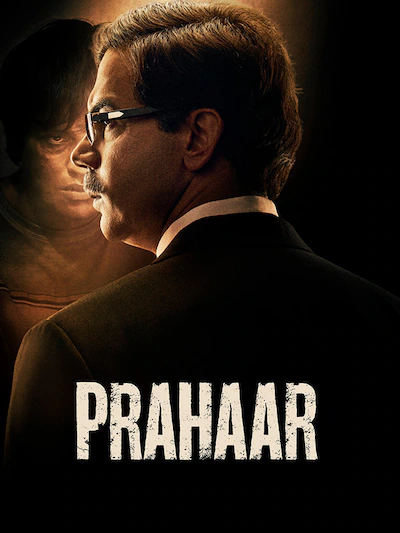
In Shahid (2013), Rajkummar Rao played Shahid Azmi, a lawyer who was shot dead in his Kurla office in 2010 while defending a man charged in the 26/11 case, who was later cleared. The role earned Rao a share of the National Film Award for Best Actor. In Prahaar, directed by Avinash Arun, he returns to the legal world of the 26/11 trial, this time on the prosecution’s side, as Ujjwal Nikam, who argued the case against Ajmal Kasab, the only gunman captured alive. Revisiting a national wound is delicate work. This story needs no decoration; its weight is already there. Prahaar is at its best when it trusts the facts, the people and the legal process. It is less certain when it reaches for emphasis, and that is where the line between recounting history and shaping it begins to blur.
How it begins
The trailer gives away the outline, yet it leaves you curious to see how the story unfolds. The film opens with Kasab and the brutality of the attack, placing Nikam alongside him from the outset. Beneath the drama is a plain lesson in criminal law: the prosecution must prove guilt beyond reasonable doubt. My favourite passage comes early, when Nikam takes on the task of establishing Kasab’s age through medical tests, a small procedural fight that reveals the man’s method before his emotions come into play. Near the end of the first half, Kasab makes a partial admission: he was part of the attack, he says, but he was forced to take part, and it was the other gunman who fired. The courtroom falls still, and the audience with it.
The performances
Lalit Prabhakar’s Kasab is among the film’s most unsettling performances. He looks strikingly like the real man, and his speech and mannerisms follow suit. Rao plays Nikam as uncompromising and rock-like, a man who gives little ground. Ritvik Sahore, as Nikam’s anguished son Aniket, brings real heat to his clashes with his father and to the scene in which he pleads with him to take him on as a junior counsel in Kasab’s trial. Sikandar Kher, as Abbas Kazmi, the real court-appointed lawyer who defended Kasab, cross-examines witnesses with a sarcastic edge. A few of his remarks seemed unnecessary to me, yet Kher keeps Kazmi’s expression composed while emotion runs beneath the surface, and the performance suits the role. Jaideep Ahlawat plays Chaudhary Zulfiqar Ali, a sharp, dignified Pakistani prosecutor who comes to Mumbai on behalf of his government. His screen time is limited, but he is less an antagonist than a human counterpoint to Nikam. The conversations over meals between Zulfiqar and Nikam are among the film’s warmest moments. Wamiqa Gabbi, as Nikam’s wife Jyoti, has a short role that adds a personal touch to his life. Known for lighter, younger roles, she is asked here to play an older woman, and her dialogue delivery feels slightly off in places. The film’s emotional core is its ten-year-old eyewitness, Komal Ahirwar, played by child actress Dior Ranju Varghese. Her testimony is bold and moving, and the film uses it to honour the courage of ordinary citizens who came forward to testify. One of Nikam’s lines to Kasab stayed with me: “Agar tumhare paas dil hai, toh main tumhein dikhaunga ki tumne kitnon ke dil tode hain.”
The second half turns towards Nikam’s family and settles into a more measured, personal rhythm. The idea is to show the personal cost of such a case: the lawyer fights it while his family absorbs the strain. The ending is predictable yet well built, turning first to Nikam’s responsibility towards his family and then to the verdict. Lalit Prabhakar’s portrayal of Kasab holds the eye to the last frame. The audience at my screening watched mostly in silence. Whenever a sharp line of dialogue landed, a ripple of excitement went through the hall, and emotions were highest during Kasab’s scenes.
Rating: 3.5/5
Prahaar is strongest in court, and its family track adds a quieter, more domestic note. According to Sacnilk, the film opened on 16 October with ₹2.35 crore net in India and earned ₹17.15 crore net by the end of its first week. Most of us remember the night of 26 November. Fewer remember the trial that followed: the evidence, the death sentence in 2010 and Kasab’s execution in 2012. A film has to select what to dramatise from months of proceedings. When a country remembers a tragedy, how much of that memory belongs to the attack, and how much to the long, procedural work of holding someone accountable?