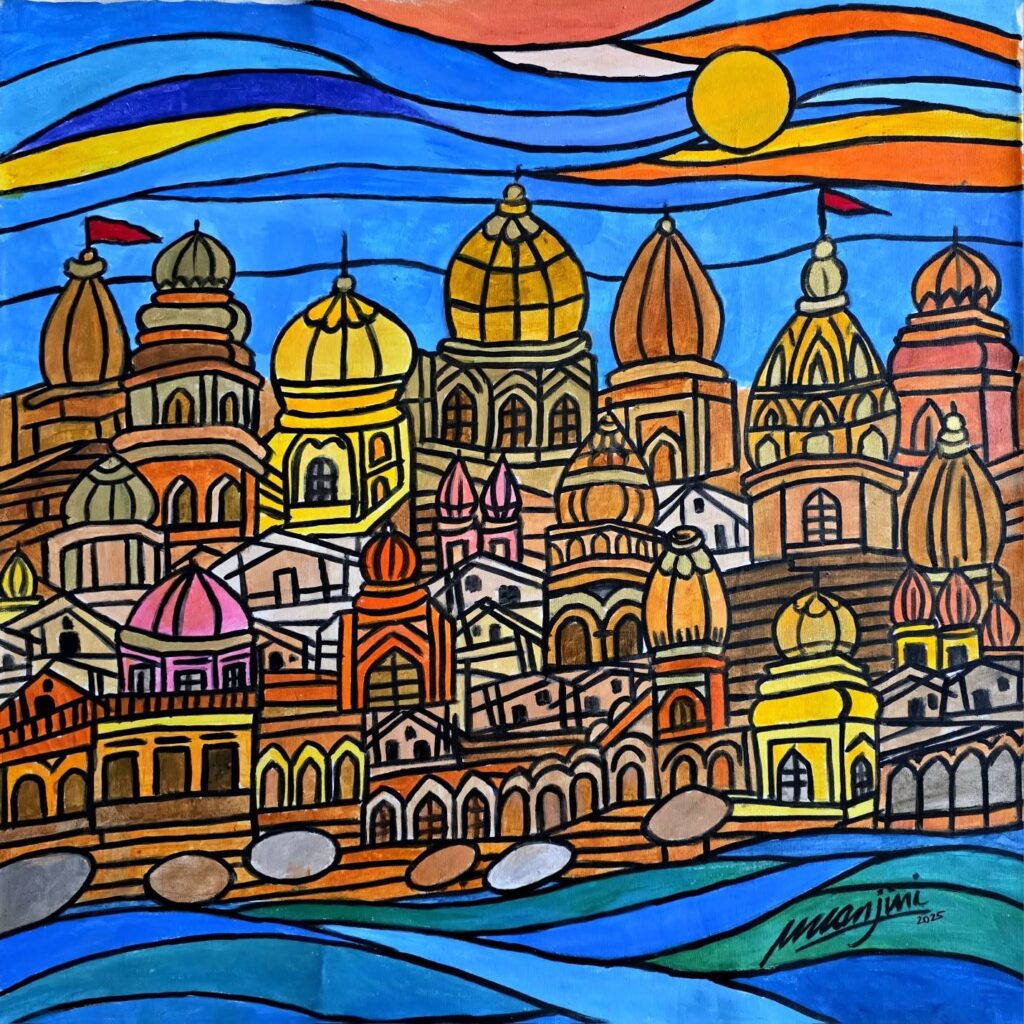
At 85, Indian-born artist Dr Anjini Prakash Laitu, affectionately known as the “Colourman of Dubai”, is challenging conventional notions of retirement. The octogenarian continues to paint, exhibit and experiment. For him, art is less about seeking inspiration than about the sheer pleasure of working with colour.
Laitu has taken an unconventional route to artistic fulfilment. After decades in the corporate world, he returned to formal art education at the Sharjah Art Institute after retiring in 2001. A member of the Emirates Fine Arts Society, he has exhibited his work in India, the UAE, Nepal, Qatar and elsewhere. His solo exhibition, Masuleh Village by Noor, held in September 2026 and presented by the NOOR Royal Collection in Dubai, reflects his distinctive approach to colour, form and landscape.
Laitu’s story is not simply about a late return to art; it is about the persistence of a creative instinct through decades of professional obligations. Retirement, for an artist who finds happiness in playing with colour, has proved less an ending than an opportunity to begin again.
In an exclusive conversation with India Dossier, he reflects on his artistic journey, the constraints faced by artists in India and the freedom to create on his own terms.
You retired in 2001, intending to return to India. Instead, you went back to school to study art. What changed your plans?
After 34 years of work, yes, it was time for me to head back home to India after retiring in 2001. But then, life had other plans. I joined the Sharjah Art Institute, studied there for three years, and finally graduated with full certification!
What inspires you to paint, even at 85?
I am an abstract painter and feel there is no requirement to get inspired or motivated. I simply play with colours, which gives me immense pleasure, joy and eternal happiness. I believe in my work and my style.
That relationship with colour extends well beyond the canvas. Wearable art is not a recent experiment for Laitu. During his working years, he kept his artistic instincts alive by painting on fabric, including saris. His wife would wear his hand-painted saris, and he later worked on fabric with fashion designers in the UAE, including Walid Atallah. Shirts, denim, belts and even shoes have all become canvases for his art.
Perhaps that explains his wardrobe, too. With Laitu, colour is not restricted to what hangs on a gallery wall; he quite literally wears his art.
You have spent decades balancing a professional career with your passion for art. What were the biggest challenges you faced?
The biggest challenge for me has been time. I had been working with Thapars in India and retired as their branch manager from the South. Later, I came to Dubai to put up a glass bottle-making plant. During these years, the time to create art was very limited.
At 85, I cannot afford to spend 12 to 15 hours creating new artwork.
How has the art scene in India evolved over the years, and what changes have you witnessed in the appreciation of art?
The art scene in India is emerging, but at a very slow pace. Artists don’t get a chance to create what they want. They are generally tied up with jobs and can’t think and work independently.
With the country’s economic growth, millionaires have experienced much growth, but sales of good work have not increased in that proportion, which is a matter of concern.
What advice would you give aspiring artists looking to find their own voice and style?
Looking at the current times, taking care of your livelihood is advisable first. You can create original work if you are free to think and not tied up with financial or other liabilities.
His advice reflects his own experience. Having spent decades balancing work and creativity, Laitu believes that financial independence gives artists greater freedom to create without commercial compulsion. It allows him, he says, to pursue art for pleasure rather than out of financial necessity.